The Foundation
Single Source of Truth, Explained
When "revenue" means the same thing in every system, an entire category of confusion disappears.
A single source of truth is not a dashboard. It is not a spreadsheet that someone keeps updated. It is a structured, normalised data layer where every metric has one definition, every entity has one identifier, and every number can be traced back to its source. When your CFO, your sales lead, and your operations manager all look at "revenue," they see the same number — because it comes from the same place, calculated the same way.
Why Most Businesses Do Not Have One
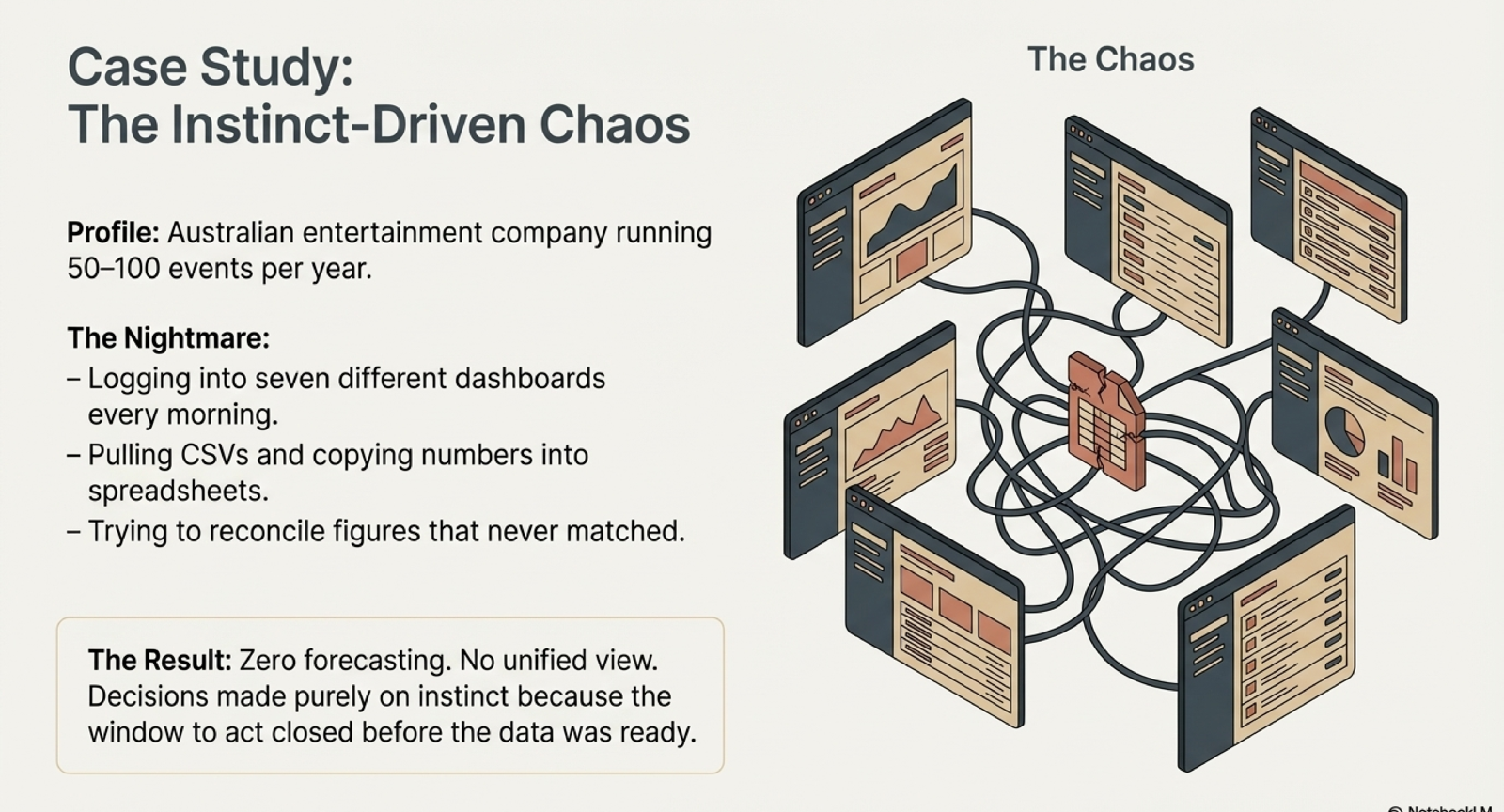
In the early stages of a business, a single source of truth is your founder's head. The numbers are simple enough to hold in memory. As you scale, the numbers fragment across systems: revenue in the accounting platform, pipeline in the CRM, operational metrics in custom spreadsheets, marketing data in yet another tool. Each system has its own definitions, its own logic, its own version of "the truth." Nobody planned for this divergence. It happened gradually, as each team adopted the tools that solved their immediate problem.
The Cost of Multiple Truths
When different teams work from different numbers, every meeting starts with a reconciliation exercise instead of a decision. "Where did you get that number?" becomes the most common question in your leadership meetings. Trust in data erodes. People revert to instinct. Experian research found that 95% of organisations see negative business impact from poor data quality1. And the person who is best at arguing wins the decision, regardless of whether they are right. This is not a data problem in the abstract. It is a decision-making problem that directly impacts your commercial performance.
95%
of organisations see negative impact from poor data quality
Experian, 2019
If your leadership meetings start with "where did you get that number?", you do not have a single source of truth.
What Building One Actually Involves
Building a single source of truth requires three things. First, connecting your operational systems — extracting data from every platform where it currently lives and bringing it into one place. Second, normalising that data — creating consistent definitions, resolving duplicates, and building a data model where every metric is unambiguous. Third, storing it in infrastructure that your team can access — a modern database that powers dashboards, reports, and analytics from one consistent layer.
The Unlock
Once you have a single source of truth, things that used to take days take minutes. Board packs assemble themselves. Forecasts are built on reliable historical data. Harvard Business Review found that only 3% of companies' data meets basic quality standards2 — a single source of truth is how you join that elite minority. New team members can ramp up by exploring one structured data layer instead of asking five different people for five different spreadsheets. And when an investor or acquirer asks for your numbers, you can produce them instantly — a signal of operational maturity that directly impacts valuation.
Sources
- Experian, "Global Data Management Research" (2019)
- Harvard Business Review, "Only 3% of Companies' Data Meets Basic Quality Standards" (2017)
Related Capabilities
Infrastructure & Database Modernisation
Legacy systems and fragmented databases slow everything down. We modernise your data infrastructure — warehousing, pipelines, and platforms — to eliminate silos, reduce cost, and establish the single source of truth your organisation can scale on.
Business Intelligence & Decision Systems
Executives need clarity, not dashboards for their own sake. We build reporting and decision systems anchored to your commercial priorities — replacing manual processes with real-time intelligence leadership can act on.
Continue Reading
The Foundation
What Is a Data Foundation (And Why It Matters)
A data foundation is the structured, connected data layer that powers every reliable decision, dashboard, and AI capability in your business. Learn what it is and why it is the most important investment you can make.
Read →The Problem
What Messy Data Actually Costs Your Business
Messy data creates slow decisions, wasted hours, invisible risk, and missed opportunities. Learn the real cost of scattered, inconsistent data across your business systems.
Read →The Outcome
From Spreadsheets to Real-Time Dashboards
The journey from manual spreadsheet reporting to automated, real-time dashboards. What it takes, what it costs, and why the foundation matters more than the tool.
Read →Ready to build your data foundation?
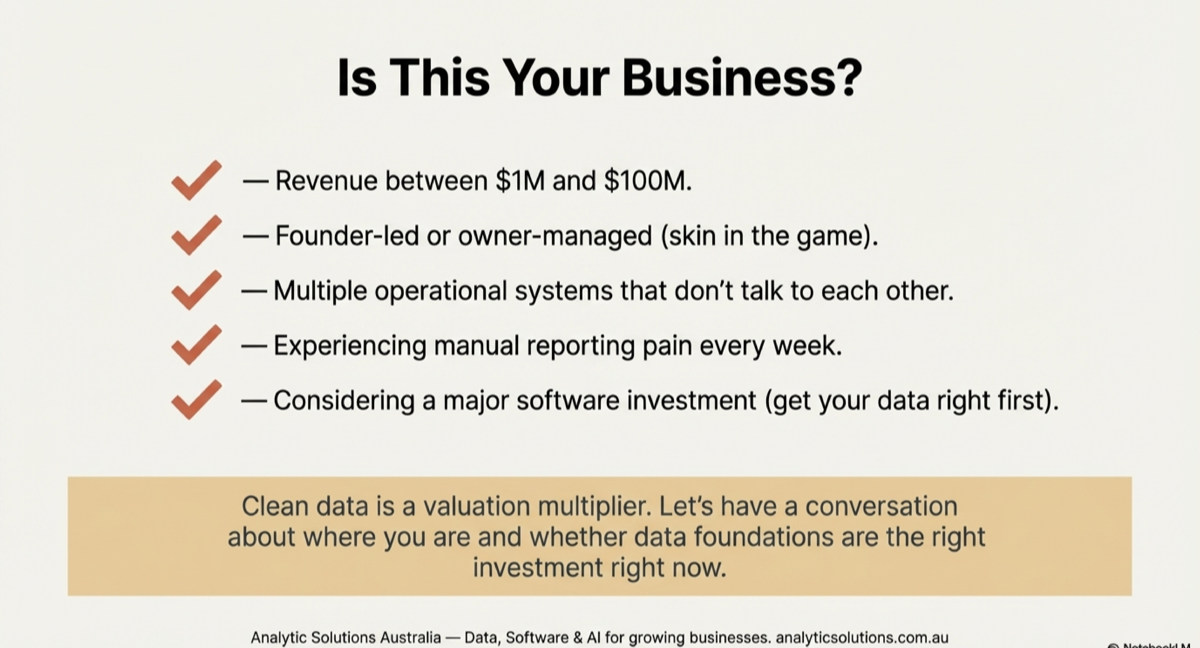
Let's have a conversation about where you are and whether data foundations are the right investment right now.
Start a Conversation