The Problem
What Messy Data Actually Costs Your Business
The five hidden costs that compound silently until they become impossible to ignore.
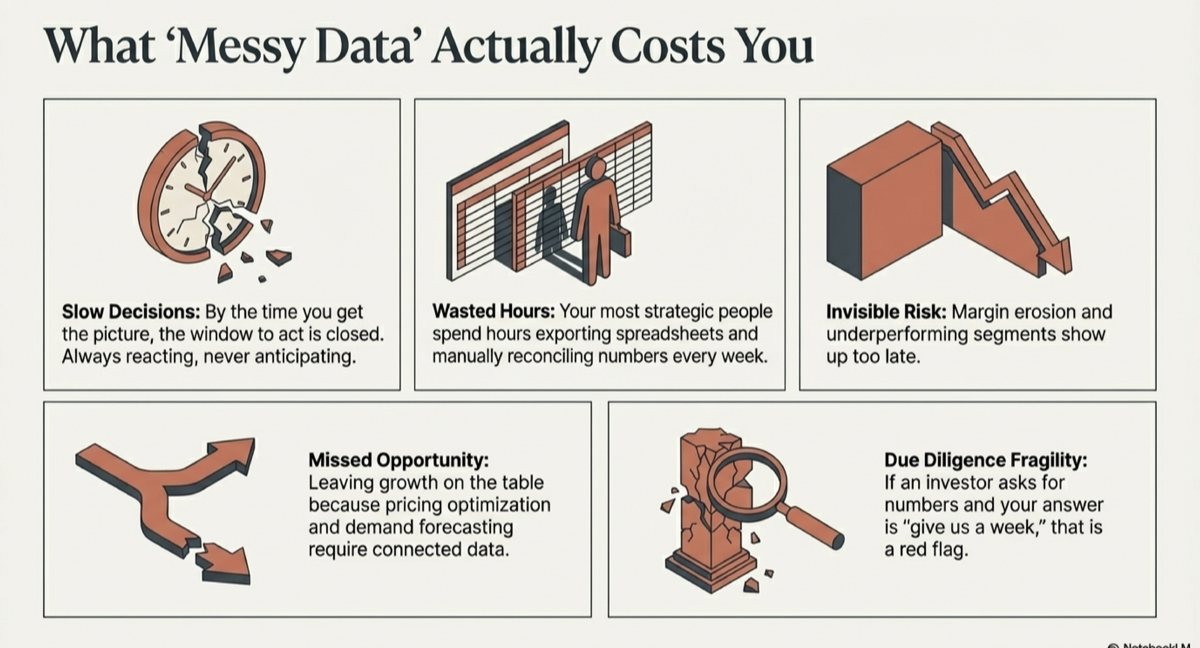
Every growing business reaches a point where the data problem becomes undeniable. Reports take days instead of minutes. Numbers from different systems never match. Your most strategic people spend hours exporting spreadsheets and manually reconciling figures every week. You are forced to make decisions on instinct because the window to act closes before the data is ready.
Slow Decisions
By the time you get the full picture, the window to act has already closed. Your leadership team is always reacting, never anticipating. In fast-moving markets, this delay is not just an inconvenience — it is a structural disadvantage. Gartner estimates that poor data quality costs organisations an average of $12.9 million per year1 — much of it hidden in delayed decisions and missed windows. Your competitors who have clean, connected data are making the same decisions in hours that take you weeks. Over time, this compounds into a widening gap in market responsiveness.
$12.9M
Average annual cost of poor data quality per organisation
Gartner, 2021
Wasted Hours
Your most strategic people — the ones you are paying to think, to plan, to lead — are spending their time exporting CSVs, copying numbers between spreadsheets, and manually reconciling figures that should match but never do. This is not a minor operational friction. It is a systemic misallocation of your most expensive resource: senior attention. Every hour a department head spends wrestling with data is an hour not spent on strategy, customers, or growth.
Invisible Risk
Margin erosion and underperforming segments show up too late when your data is fragmented. You cannot see a slow bleed in profitability if the numbers that would reveal it live in three different systems with three different definitions of "revenue." Experian found that 95% of organisations see negative business impact from poor data quality2. By the time the problem surfaces in your monthly board pack, you have already lost months of margin. This is not theoretical — it is the lived experience of most founder-led businesses scaling past their initial systems.
You are not behind because you lack ambition. You are behind because your data is scattered across systems never designed to talk to each other.
Missed Opportunity
Pricing optimisation, demand forecasting, customer segmentation — these are not luxuries reserved for enterprise. They are capabilities that any growing business should have access to. But they all require connected, structured data as a prerequisite. Without a foundation, these opportunities remain permanently out of reach, regardless of how much you spend on software or hire in analytics talent.
Due Diligence Fragility
If an investor, acquirer, or board member asks for your numbers and your answer is "give us a week," that is a red flag. Clean data is a valuation multiplier. Messy data is a discount. Whether you are raising capital, preparing for acquisition, or simply running a board meeting, the ability to produce reliable numbers on demand signals operational maturity. The inability to do so signals the opposite.
The Real Question
At a macroeconomic level, IBM estimates that poor data quality costs the US economy $3.1 trillion per year3. The cost of messy data is not a line item in your P&L. It is embedded in every slow decision, every wasted hour, every risk you cannot see, every opportunity you cannot capture. The question is not whether you can afford to fix your data. The question is whether you can afford not to.
Sources
- Gartner, "How to Improve Your Data Quality" (2021)
- Experian, "Global Data Management Research" (2019)
- IBM, "The Four V's of Big Data" / Thomas C. Redman analysis (2016)
Related Capabilities
Infrastructure & Database Modernisation
Legacy systems and fragmented databases slow everything down. We modernise your data infrastructure — warehousing, pipelines, and platforms — to eliminate silos, reduce cost, and establish the single source of truth your organisation can scale on.
Data Strategy & Architecture
Before any technology investment, the architecture and governance must be right. We define data strategy aligned to commercial objectives — the roadmap, standards, and operating model that turn raw data into a durable competitive asset.
Continue Reading
The Problem
The Growth Paradox: More Revenue, Slower Decisions
Why growing businesses hit a wall where more momentum creates slower, worse decisions. The problem is not ambition — it is scattered data across systems that were never designed to work together.
Read →The Problem
Why Software Doesn't Fix a Data Problem
The instinct when reporting breaks is to buy a new CRM, BI tool, or AI product. But software doesn't fix a data problem — it just gives you a prettier window into the same mess.
Read →The Foundation
What Is a Data Foundation (And Why It Matters)
A data foundation is the structured, connected data layer that powers every reliable decision, dashboard, and AI capability in your business. Learn what it is and why it is the most important investment you can make.
Read →Ready to build your data foundation?
Let's have a conversation about where you are and whether data foundations are the right investment right now.
Start a Conversation