The Problem
The Growth Paradox: More Revenue, Slower Decisions
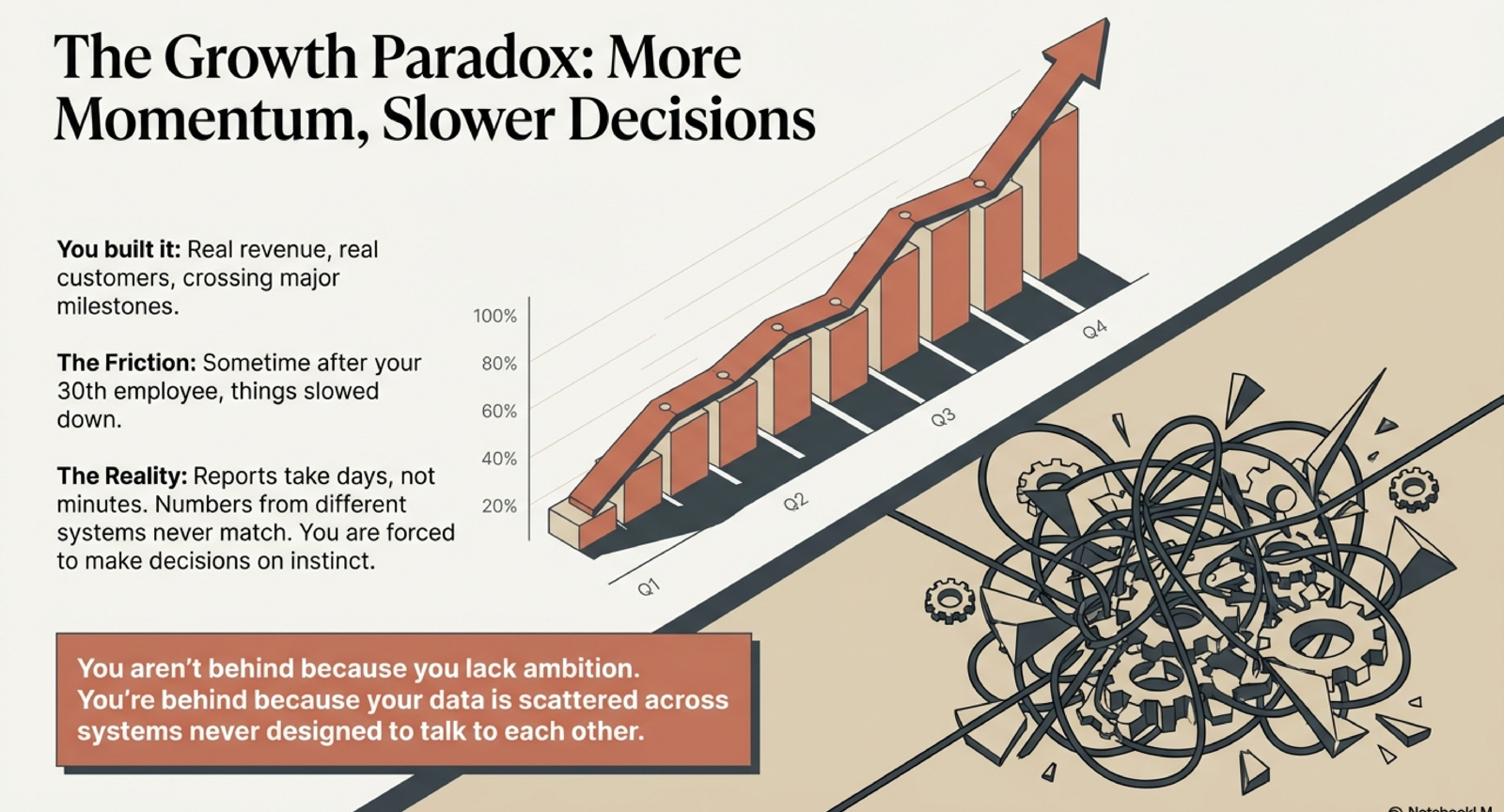
You built something real. Then somewhere after your 30th employee, things started to slow down.
You built it. Real revenue, real customers, crossing major milestones. The early days were fast — decisions made around a table, everyone knew the numbers because the numbers were simple. Then somewhere after your 30th employee, maybe your 50th, things slowed down. Not the revenue. Not the ambition. The decisions.
The Pattern Is Always the Same
In the early stages, a founder-led business can operate on instinct because the data is simple enough to hold in your head. Revenue comes from a handful of sources. Costs are visible. The team is small enough that information flows naturally. But scale changes everything. More customers mean more systems. More systems mean more data. More data — without structure — means more confusion, not more clarity. IBM estimates that poor data quality costs the US economy $3.1 trillion per year1 — a staggering figure that underscores how pervasive this problem is across businesses of every size.
$3.1T
Annual cost of poor data quality to the US economy
IBM, 2016
The paradox is that the very growth you worked so hard to create is now making it harder to make the decisions that sustain it.
Where the Friction Shows Up
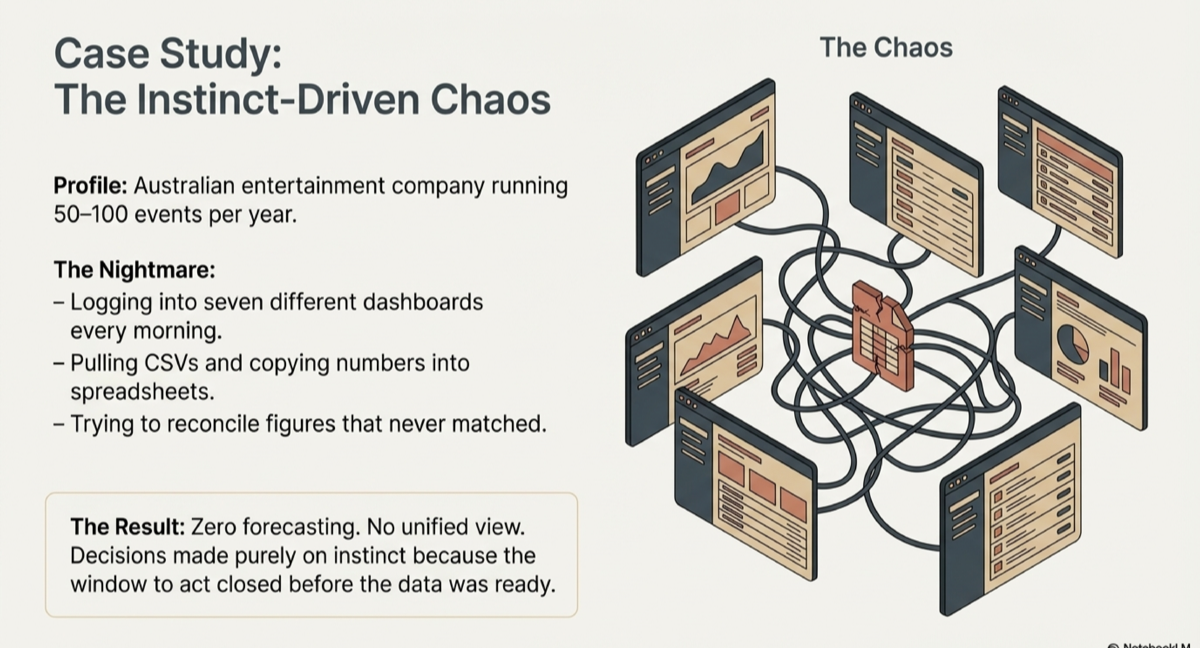
The symptoms are predictable. Monday morning, and your operations lead is logging into four different platforms to build a report that should take five minutes but takes five hours. Your finance team is reconciling numbers that never match because "revenue" means something different in your CRM than it does in your accounting system. Your sales manager is forecasting off a spreadsheet that was last updated three weeks ago. None of this is because your people are not capable. It is because your systems were never designed to talk to each other.
The Instinct Trap
When the data is too slow, too fragmented, or too unreliable, leaders default to instinct. And instinct works — until it does not. The danger is not that instinct is always wrong. The danger is that you cannot tell the difference between a good instinct and a bad one without data to validate it. McKinsey research shows that companies in the top quartile for data-driven decision making are 5% more productive and 6% more profitable than their competitors2. At scale, the cost of a wrong instinct-driven decision is orders of magnitude higher than it was when you were a ten-person company.
This Is Not a Technology Problem
The temptation at this stage is to buy software. A new CRM. A better BI tool. An AI product that promises to "unlock insights." But none of these tools will solve the underlying problem, which is structural: your data is scattered across systems never designed to work together. No amount of dashboard tooling will make scattered, inconsistent data reliable. The tools are not the problem. The foundation is.
Breaking the Paradox
The businesses that break through this wall are not the ones that buy more software. They are the ones that invest in the unsexy, foundational work of connecting their systems, normalising their data, and building a single source of truth. This is not glamorous work. But it is the work that turns your growth from a liability back into an asset — giving your leadership team the clarity to make decisions in minutes that currently take days.
Sources
- IBM, "The Four V's of Big Data" / Thomas C. Redman analysis (2016)
- McKinsey Global Institute, "The Age of Analytics" (2020)
Related Capabilities
Data Strategy & Architecture
Before any technology investment, the architecture and governance must be right. We define data strategy aligned to commercial objectives — the roadmap, standards, and operating model that turn raw data into a durable competitive asset.
Infrastructure & Database Modernisation
Legacy systems and fragmented databases slow everything down. We modernise your data infrastructure — warehousing, pipelines, and platforms — to eliminate silos, reduce cost, and establish the single source of truth your organisation can scale on.
Continue Reading
The Problem
What Messy Data Actually Costs Your Business
Messy data creates slow decisions, wasted hours, invisible risk, and missed opportunities. Learn the real cost of scattered, inconsistent data across your business systems.
Read →The Foundation
Data Foundations vs. The Big Software Purchase
When reporting breaks, the instinct is to buy new software. Here is why investing in your data foundation first is more capital-efficient and delivers better outcomes than any tool purchase.
Read →The Transformation
Data Strategy Roadmap for Growing Businesses
A practical framework for building a data strategy that starts with your business problems, not technology. How to sequence your data investments for maximum return.
Read →Ready to build your data foundation?
Let's have a conversation about where you are and whether data foundations are the right investment right now.
Start a Conversation